
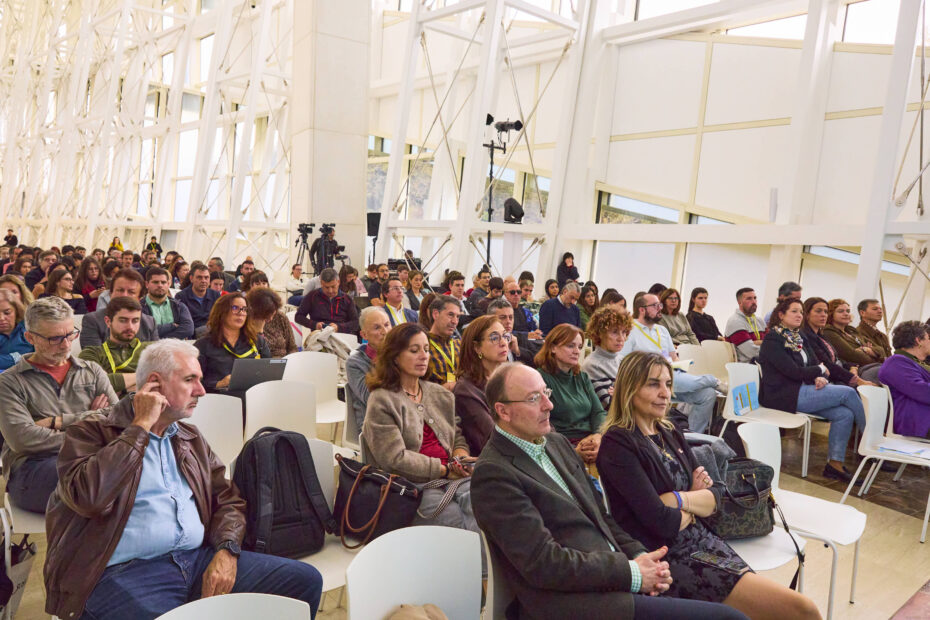
Following the excellent reception of its open day, the VI Fairway continued today, focusing on issues that matter to the sector. The search for excellence in sustainability and touristification were the focus of this morning’s debates, facilitating the expression of different points of view by the various agents involved in the development of the Jacobean Routes.
The opening conference was moderated by Fairway co-director Tono Mugico and featured the director of the Galician Tourism Agency, Xosé Manuel Merelles, and the vice-president of the A Coruña Provincial Council, Xosé Regueira. Both agreed that the Camino de Santiago is one of the tourist products par excellence of Galicia in general, and of the province of A Coruña in particular. Given the success of the Jacobean Routes, both Merelles and Regueira highlighted the importance of working on joint management models that promote both the professionalisation and promotion of a key sector in the economic development of the region.
In this regard, Xosé Regueira recalled that the ‘opportunities’ offered by tourism linked to the Jacobean Routes must be exploited, as it is a ‘lever for the economy’ in the community. Merelles, for his part, stressed that ‘sustainability is the key to the growth of the tourism model’, based on principles such as ‘unity, equality and pluralism’.
Intense debate on touristification
After this first session, a round table discussion on touristification was opened, moderated by journalist, writer and communications expert Pati Blanco, with the aim of contributing different points of view on this highly topical issue. The common thread running through all the contributions was the need for public-private cooperation in the management, maintenance and promotion of tourism in general and that associated with the Camino de Santiago in particular.
Ildefonso de la Campa, director of the S.X. del Plan Xacobeo, argued that touristification as such does not exist today. However, he did stress the importance of ‘working in a coordinated manner’ through ‘constant dialogue’ between public and private entities, always bearing in mind that ‘inclusivity in tourism’ must be sought. To this end, the sector must be aware of and adapt to market needs. ‘We must be very attentive to supply and demand,’ he said.
A more local perspective was provided by María Luisa Rodríguez, president of the Association of Municipalities of the Camino Fisterra-Muxía, who highlighted the ‘advantages’ that the Jacobean routes have brought to the region. ‘They have brought a lot of life to the municipalities,’ she said, emphasising the importance of promoting, caring for and properly managing this tourist product.
From the neighbouring country, Teresa Ferreira, director of the Department for the Promotion of Tourism Resources at Turismo de Portugal, stressed the importance of developing actions that allow for ‘the dispersion of tourist flows’, as well as ‘joint work between institutions and economic agents’. She also mentioned that we must commit to this ‘value proposition that must be associated with the Caminos de Santiago’, promoting lesser-known itineraries and attracting visitors through the ‘cultural and spiritual value’ of the towns they pass through.
For his part, Jorge Carregal, head of communication at INCOLSA-Turismo de Santiago, stressed that touristification ‘is not a problem, but a reality’, pointing out that Santiago is a destination ‘at risk of overcrowding’. Therefore, it is necessary to ‘assess the situation and take corrective measures’. This is something that Santiago City Council plans to do by drawing up a ‘strategic plan’ aimed at ‘changing the city’s tourism model’ and seeking ‘improvements in quality’.
Regarding the changes, the president of the Galician Tourism Cluster, Cesáreo Pardal, referred to a problem of ‘lack of coordination’ in areas such as ‘airport connections’. He also stated that tourism management requires the creation of ‘a regulated offer as a business activity’ linked to the tourism sector.
Bernardo Fernández, president of the Association of Municipalities of the English Way, indicated that ‘the infrastructure has not grown at the same rate as demand.’ In this regard, he defined this situation as ‘a business opportunity,’ while noting that ‘the sector itself must regulate itself’ in this regard.
From a technical perspective, José María de Juan Alonso, managing partner of Koan Consulting, referred to the need to analyse ‘the situation from a comprehensive perspective’. To this end, ‘policies must be coordinated to achieve sustainable, quality tourism’.
The Tourism and Camino Forum continues this afternoon with a training workshop on monitoring given by Ignacio Fernández Zabala, director of Handmade Marketing. In the session, he will show attendees how to use digital tools to define KPIs and use them to benefit a tourism business.
Workshop and presentations
This morning, Fairway also kicked off the largest workshop sessions in its history, with the participation of 43 tour operators from 18 countries who will meet with around 140 companies offering services on the Camino de Santiago. More than 3,000 professional meetings are expected to take place between today and tomorrow.
In addition, presentations were given today on various destinations and initiatives such as the Portuguese Routes of Santiago, the activities of the Association of Municipalities of the English Way, the Fisterra-Muxía Way, the Way of the Cross of Caravaca, the Vertical Way and the cycle tourism specialisation of the Vía de la Plata as it passes through the province of Ourense. As a complement, activities such as escape rooms and guided beer tastings are also being held.