
The second day of the Tourism and Camino Forum at the VI Fairway was marked by two intense debates. The one that generated the most excitement was entitled Tourist Tax: Where Does the Money Go?, moderated by Manuel Carneiro, contributor to Economía Digital and analyst.
While the councillors for Economy in A Coruña and Tourism in Santiago, José Manuel Lage and Míriam Louzao, respectively, maintained a clear position in favour of the tourist tax, the president of HOSPECO, Agustín Collazos, and the spokesperson for the Santiago Hotel Union, José Antonio Liñares, expressed their opposition to this tax. Despite these opposing positions, during the debate, all parties reached a common ground: the creation of specific labels that would allow the population to know what resources and/or services the money collected through this tax would be used for.
In this regard, Lage announced that A Coruña City Council is working on a ‘specific label to identify the policies in which the tourist tax is invested’, the main areas of which include ‘heritage conservation, cleanliness and public transport. This tax will be traceable, will contribute to sustainable development and will promote those elements that will also help to improve the quality of the visitors we have,’ he said.
For her part, Louzao considered this proposal to be a good one, although she also explained that the Santiago City Council will promote a ‘Sustainable Tourism Forum’ in which the opinions of all the agents involved will be gathered on ‘the proposals that will be made by the City Council regarding the application of the tourist tax.’ Among the main objectives to be achieved is the implementation of ‘policies for the decentralisation and deseasonalisation of tourism,’ said the Compostela councillor.
In contrast, the hotel and hospitality sector expressed its dissatisfaction with the ‘administrative burden’ that the application of this tax has placed on the sector. In the words of Agustín Collazos, ‘they have put the band-aid on before the wound and are applying a tourist tax in a city that, on average, has a 60% occupancy rate’. Liñares agreed, stating that ‘the destination should be more established’ before introducing this type of tax.
Both Liñares and Collazos were in favour of measures to show the return of the tourist tax to the population as a whole, although they raised some issues to be taken into consideration. The president of HOSPECO suggested the possibility of investing in airport policies or in the marketing of the destination itself, with a special focus on measures that promote accessibility, enabling everyone to visit the cities in the best possible conditions.
More dialogue on the management of the Caminos
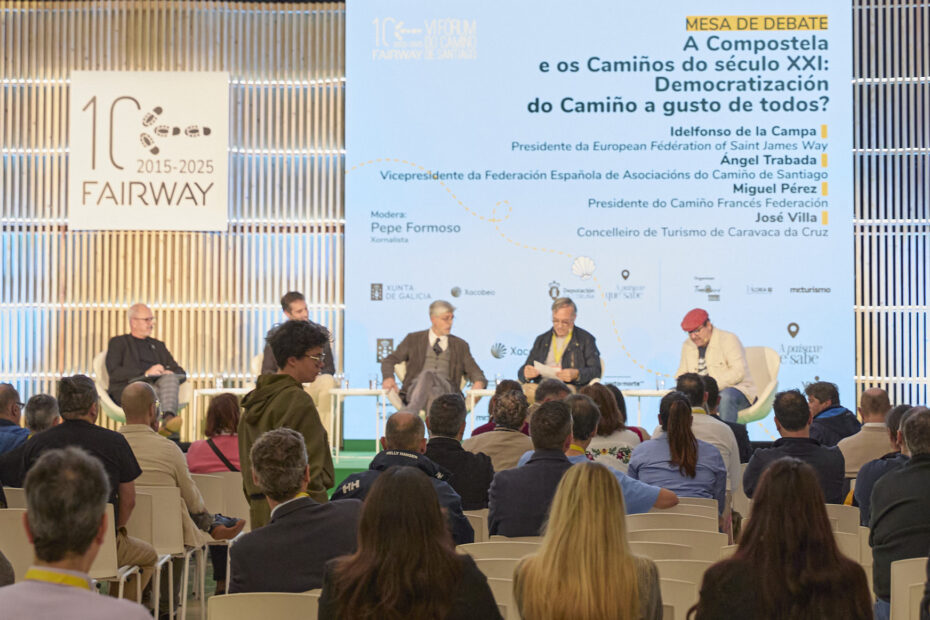
Another major topic of debate during the morning was the round table discussion entitled La Compostela and the Caminos of the 21st Century: Democratisation of the Camino to everyone’s liking?, moderated by journalist Pepe Formoso. All the participating representatives regretted that the Cabildo of Santiago de Compostela was ultimately unable to attend the meeting, as it had been hoped to discuss the recent changes made to the regulations for obtaining the Compostela.
Ildefonso de la Campa, president of the European Fédération of Saint James Way, recalled that ‘the Way is originally a Catholic Way’ and that its ‘democratisation’ was carried out thanks to the efforts of the Catholic Church. Therefore, in his opinion, decisions in this regard, such as the regulations governing the Compostela, are the responsibility of religious entities.
This was a point on which neither Jorge Martínez-Cava, representative of the Spanish Federation of Associations of the Camino de Santiago, nor Miguel Pérez, president of the French Way Federation, agreed. They highlighted the need to ‘coordinate efforts’ and establish ‘a dialogue’ with all parties involved in the Camino -public and private sectors- in order to establish measures for managing the Jacobean routes with the Church.
Regarding this union, José Villa, Councillor for Tourism in Caravaca de la Cruz, cited the Camino de la Cruz Foundation as an example of this union. “Tools such as this help to ensure that decisions regarding the Camino are taken by consensus, as coordination is essential. For now, the Foundation is having a very positive impact and has led to improvements on the Camino,‘ he explained. De la Campa congratulated Villa on having a ’very well-established” organisation, and the participants at the table positioned it as a possible model to follow.
The Tourism and Camino Forum concluded its second day with a workshop on Chat GPT applied to tourism businesses. The activity was led by Juan Frejo García, AI expert at El Ninja Fluorescente, and moderated by Andrés Romero, CEO of Asiri Marketing. During the session, Frejo offered a series of recommendations for the use of artificial intelligence in the management of companies in the tourism sector, through tools available online and other guidelines that allow for the optimisation of business processes and resources.
Another successful workshop
This afternoon also marks the end of the workshop section, with 3,500 business meetings held between 43 international tour operators and 140 companies offering services on the Camino de Santiago. The activity has been another success among participants.
The VI Fairway bids farewell this afternoon with the Sensory Routes through Beer Culture, led by Martín Gómez, Beer Culture Technician (Hijos de Rivera). The activity will end with the closing of the exhibition space and the last of the prize draws for the tenth anniversary.